The newest Broadway-style stage show debuting on the Disney Destiny, Hercules on Disney Cruise Line was a BIG reason why I booked my sailing as close to the maiden voyage as my schedule would allow. I adore the Hercules music and movie. Yes, I know it isn’t authentic. Yes, I know it’s pretty problematic in a lot of ways. But I love the interpretation of the Greek Chorus as a Gospel Choir—and in this production, the Muses are clearly the emotional engine, though they’re asked to do an exhausting amount of heavy lifting for a show that often feels at odds with itself.
Before getting into it, a necessary disclaimer: Having just come from the West End production of Hercules, I walked into the Walt Disney Theatre with a specific set of expectations. While I’ve tried to let this version stand on its own, that comparison inevitably colored my view.
The Gospel Truth
We may have had a number of performers out sick—including a Muse who stepped into the role of Hercules and absolutely slayed (while we were down a Muse overall)—but even accounting for the chaos, something felt fundamentally off. The stage never quite “filled in” the way it does during Beauty and the Beast, also featured on the Disney Destiny. There was this persistent sense of negative space that never resolved; it felt like the production was missing its “connective tissue.”
Bottom line: the performers are fantastic, but they’re fighting an uphill battle. The material isn’t as faithful to the classic score as other DCL shows, the set pieces feel awkwardly out of proportion to the stage, and the cast—despite their talent—ultimately feels small against the backdrop.
From Zero to Hero
Let me be very clear: the performers deserve their flowers.
The comedic timing across the cast is top notch. Pain and Panic are hilarious together, and Pegasus and Phil deliver some of the best background “eyebrow acting” on Disney Cruise Line — moments where they aren’t meant to be the focus, but absolutely elevate the scene anyway.
Hades’ first costume is stunning. My mom genuinely thought he was on skates because of how smoothly he glided across the stage. Megara sounded spot on, and even with only four Muses, their harmonies and energy gave me chills. The Muses are, without question, the emotional engine of the show.
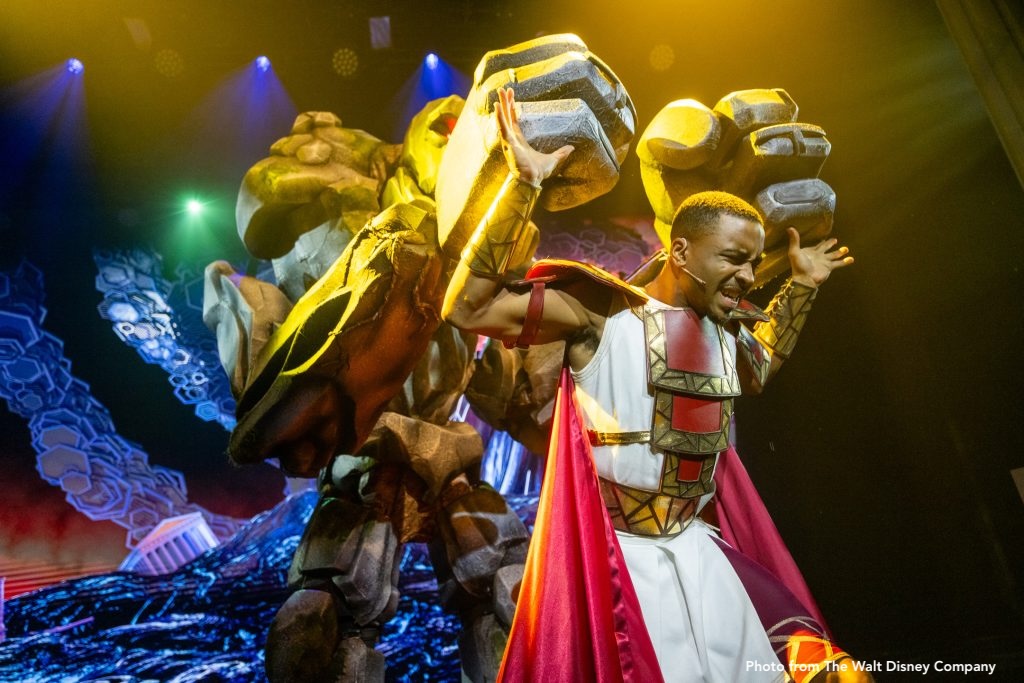
The puppetry is another major win. From the Hydra to the completely unmentioned-by-everyone scenic puppets used in the Underworld scene — which had my jaw on the FLOOR — the craftsmanship here is incredible. Those Underworld elements added a level of immersion I hadn’t quite experienced on Disney Cruise Line before. The Titans are imposing, terrifying, and beautifully constructed, with a slow, lumbering presence that feels appropriately mythic.
I want to repeat this because it matters: some of the best performers I’ve ever seen on Disney Cruise Line are in this show. My frustrations are not with the talent onstage — they’re with the book, the arrangements, and the staging choices around them.
Going the Distance…Slowly.
Now to air my grievances.
First, the staging feels miscalibrated. The set is simply too big for the Disney Destiny’s Walt Disney Theatre. Huge moving staircases meant to look like rough-hewn wood clash with the sleek projection mapping and dwarf the actors. Instead of adding grandeur, the physical design swallows the performers whole, reinforcing the sense that the show’s scale was never properly “shrunk” for a ship.
Then there’s the sound. Despite the show’s Gospel roots, that influence feels surprisingly thin. I’d heard the creative team was angling for a more modern R&B sound, and it shows. Personally, I’m a Hercules “purist,” and this shift actively guts the emotional core of Alan Menken’s score.
The inclusion of the restored song “Shooting Star” is a massive head-scratcher. Originally the track that “Go the Distance” was written to replace, here it’s repurposed as a duet between Hercules and Meg about being outcasts. It’s a lovely melody, sure—but it brings the plot to a grinding HALT.
By this point in the show, the performers have already sold the chemistry; we can see they’re falling for each other through the acting alone. We don’t need a five-minute ballad to spell out a connection the cast has already established to my full satisfaction. It feels like a “bonus feature” that belongs in a DVD menu, not in a live production where momentum is everything. It’s the kind of structural bloat that keeps the show from feeling tight, and it’s especially frustrating knowing this is likely the version that will stay on the Disney Destiny for years to come.
And don’t get me started on “A Star Is Born.” The repeated echoing of “star” and “born” drags on about three measures too long. I understand the logistical need to get the set into place, but watching the cast move the pieces, hit their marks, and then just… stand there for several beats kills the energy. The moment has already landed, the transition is over, and yet the music keeps looping. It feels less like a grand finale and more like a theatrical waiting room. It needs to be tightened, but since Disney rarely—if ever—circles back to re-edit a show once it’s live, this “clunk” is likely baked into the experience for the foreseeable future.
The costuming choices frequently pull the rug out from under the storytelling. The chorus costumes skew heavily modern—think denim skirts with rivets and visible gold seaming—but they lack any narrative “bridge” to justify the look. In The Tale of Moana, contemporary textures are grounded by a present-day framing device. Here, we’re supposedly in Ancient Greece, so the modern styling feels less like an intentional “vibe” and more like a visual non-sequitur.
The inconsistency is what really stings. Hades remains firmly rooted in a film-faithful, mythic silhouette, proving the production can commit to that aesthetic when it wants to. Meanwhile, the rest of the cast sits in a confusing middle ground of modern tailoring and ancient drapes. Pain and Panic go full industrial in overalls and boiler suits; it’s a look that works for Hadestown, but feels lost in a Disney production that hasn’t established those rules. Without a consistent visual logic, these choices don’t read as “edgy”—they just feel uneven.
Even the Titans, as visually impressive as they are, flatten the emotional stakes of the final battle — which is especially frustrating given that this is the climax of the show. This should be the show’s high-water mark: Hercules has traded away his strength and is at his most vulnerable.. This is the moment when the danger should feel real.
Instead, the confrontation unfolds with a strange restraint. While the craftsmanship of the Titans is undeniable, their sheer bulk and mechanical movement slow the momentum to a crawl at the exact moment it should spike. Without specific lighting or sound design to heighten the threat, the fight feels plodding rather than perilous. We should be terrified for a weakened Hercules, but instead, the sequence feels oddly blasé—a technical marvel that is, unfortunately, emotionally inert.
Is A Star Born?
This is an ambitious production filled with extraordinary talent and moments of real brilliance. But ambition alone isn’t enough. Hercules modernizes aggressively — in sound, design, and staging — without always aligning those updates with the story’s emotional needs.
That’s what makes this show so frustrating. Not that it reaches too high, but that it so clearly could have landed stronger with different structural choices. The pieces are there. The performers are there. The heart is there.
For a show built on myth, music, and muscle, it shouldn’t feel this uneven. And that unevenness is what ultimately keeps it from greatness.
 Midlight Labs
Leave a comment